
News from 2021 – reopening after the Coronavirus closure…
September 2021: We welcomed visitors to the Archives Room again from 7th October 2021, having had to close it and also present our evening talks online via Zoom for the 2020-2021 season. We were able to co-lead two local Ravenstonedale village heritage walks on Saturday 12th June 2021 with Westmorland Dales Landscape Partnership, and another walk on 24th July for local folk who couldn’t get booked on those two earlier walks as they sold out so quickly!
The last talk in our 2019-2020 season wasn’t on Wednesday March 18th at 7.30pm in Newbiggin-on-Lune Public Hall by Val Fermer – Who Used to Live in Your House? Of course we had to postpone this due to the Government Coronavirus guidelines, but we started the next season’s talks programme with this talk. Some details of the previous talks in the 2019-2020 season are below.

Our February 2020 talk by Jackie Wedd was based on the recollections of Mary Townsley (born Mary Straughan in Newbiggin-on-Lune in 1908). Jackie was able to use photographs from the Parish History archive to illustrate her research which drew on a document entitled Mary’s Memories donated to the History Group along with other material when Ravenstonedale School closed in 2014. Jackie was able to track down Mary’s son who fortunately was the member of her family who had given the document to Ravenstonedale School and so knew all about it, and was able to supply extra material and family photographs for Jackie to incorporate into the talk.
Mary recalled the domestic routine of each day of the week, undertaken by her mother on her own (with some help from her three daughters) during the Great War. Mary’s father William Straughan, who worked at Pratt’s Tailors in Newbiggin, was away serving with the Border Regiment in India throughout the War. Every day had its allotted tasks – Monday washday, Tuesday ironing day, Wednesday baking day, Thursday cleaning upstairs rooms, Friday cleaning downstairs rooms (and hairwash night), Saturday polishing and cleaning silver, copper and knives – although Mary herself escaped many of these Saturday tasks as she walked to Ravenstonedale from Newbiggin-on-Lune for her piano lesson from Miss Isabella Potter at Potter’s Shop. On Sundays housework was kept to a minimum (sew on a Sunday – sew for sorrow) and church was attended twice – plus Sunday School.
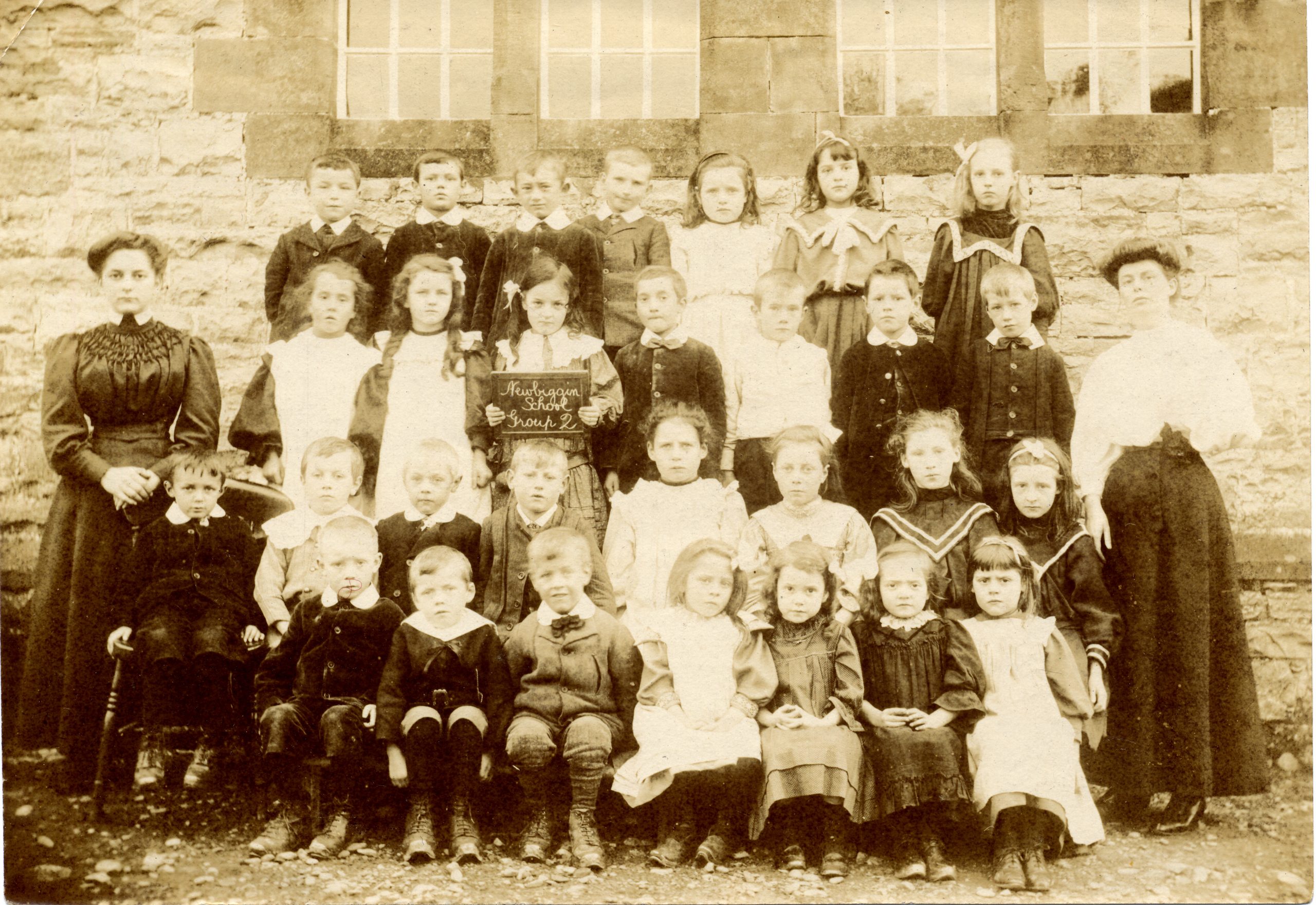
Mary’s recollections of primary school in Newbiggin were illustrated by Jackie with photographs belonging to the Parish History Group, including school photographs and digital photographs of pages from the Newbiggin-on-Lune School logbooks, kept daily by the teachers. The actual books are now in the Cumbria County Archive. Details of the syllabus for each class were given, as well as attendance records – which always showed a dip when it was haymaking time! Haymaking duties for the children were described by Mary and again illustrated with more photographs from the History Group’s collection, this time copies of Frankland family photographs of haymaking at Needlehouse made with the late Helga Frankland’s permission.
Mary produced her volume of memories of her early childhood with her grandchildren in mind, and with the help of Mary’s son, Jackie was able to bring Mary’s Memories to a wider audience in the rural Westmorland Parish where she lived, which on the night included not only Mary’s son but also one of her grandchildren for whom the Memories had been written.
Steve Fermer’s talk in January 2020 on the stories literally uncovered when he and Val redecorated one of the rooms in their house was a fascinating insight into not only the interior decorating fashions of the past but also glimpses into life in the 1880’s from the stories literally uncovered in the scraps of the Carlisle Patriot newspaper used to line the walls – scraps which could be identified and pieced together with the help of the British Newspaper Archive. The audience learnt about the revolution in mass-produced wallpaper when block printing was superseded by machine printing in the 1830’s. In the space of one generation wallpaper became available to nearly everyone with prices as low as one farthing a yard. The weather report from 1880 predicted unseasonal weather for northern farmers, due to rain and below average sunshine – no change there then!
The Christmas get-together on 11th December 2019 at Newbiggin-on-Lune Public Hall began with the transformation of the kitchen into a courthouse for a short dramatised reading of a local court case in 1921 which was reported verbatim in the Penrith Observer at the time. The detailed circumstances of an accident involving a motor car hitting and killing a bull in the road outside Rayne Farm were recounted, with claim and counter-claim between the car owner (played by his great-nephew!) and the farmer as to who was responsible and what damages should be awarded. After a long day in court (mercifully not enacted in real time) the judgement was announced and it transpired that the only “winners” in the case were the advocates! After suitable refreshments, the 20 or so members and friends then endeavoured to find answers to Dave’s local history quiz. This required varied local knowledge – everything from facts about Lady Anne Clifford’s long and eventful life as she fought to claim her rightful inheritance (featured in June Hill’s talk in October) to the identity of the local lady who iced Emlyn Hughes’s wedding cake in the early 1970’s…(Marjorie Whitfield). Bill kindly played for us so we could sing carols to round off the evening, and as usual the committee members would like to thank everyone for bringing and sharing the food and drinks and for doing the washing-up afterwards!
Harry Hawkins gave us a very informative talk in November 2019 about the importance of sheep to the local economy over the centuries, from the Neolithic Age until the 1700’s, including the significant involvement of our local monasteries. To begin with, sheep were primarily kept for milking, and it was only around 1200 that it became economically viable to produce wool for cloth. Wool was in fact not only used for the manufacture of cloth for clothing, but also for sails – the Vikings in particular used wool to make their sails – the wool from 2000 sheep would be needed to make one woollen sail of 85 square metres.
By 1086, the Domesday Book recorded that sheep were more numerous in England than any other type of livestock. (Unfortunately of course, Domesday did not reach as far as our area – Westmorland and areas of Cumberland were part of Scotland at that time, but no doubt that statistic applied to this area as well!)
By the late 1200’s , there was even a “wool futures market” – merchants would estimate and pay in advance for the anticipated wool production in a particular year – and of course any failure of wool supply for whatever reason would produce debt (nothing new under the sun…) Production was measured in sacks – hence the Woolsack in the Houses of Parliament – and the monasteries were heavily involved in production. As one sack could contain wool from between 150 to 250 sheep, and for example Holme Cultram Abbey sent over thirty sacks to merchants in one five-year period in the 1270s, it can be seen how vital this trade was to the monks.
And what of the shepherds? They were expected to have good morals, and avoid taverns and bawdy houses…surely a measure of how important their work was.
June Hill’s fascinating talk at Newbiggin-on-Lune Public Hall in October 2019 about the life of Lady Anne Clifford, who spent much of her life trying to obtain her rightful inheritance of her father’s estates, was attended by about 30 members and friends.
Our programme of evening talks began on Wednesday 18th September 2019 – an entertaining look at the history, mysteries and stories about Tower House in Newbiggin-on-Lune, which has been associated over the centuries with local Fothergill families. One of our members, Diana Fothergill, is descended from a branch of the Fothergills who lived at Fell End, but she chose Tower House as the subject of her talk, a house once in the same ownership as nearby Brownber Hall, and with Fothergill connections from the 1570s. Diana recounted mysteries including stories about secret passages, a datestone which once read 1689 but which no longer bears any date, and the original purpose of the tower itself – the current tower dates from the 1800’s when it was rebuilt using the stone from the original tower. We heard about various members of the family who lived at the house over the centuries, including during the prosperous times in the second half of the nineteenth century when John Fothergill owned the Brownber estate and built Brownber Hall, and his son (John William) who became High Sheriff of Westmorland in 1911. Unfortunately an ill-fated creamery business started in 1912 by John Hugh Fothergill bankrupted that branch of the family, and the Brownber estate was auctioned in 1930 and split up. However John Hugh Fothergill and his family were allowed to stay on at Tower House for a peppercorn rent. In the 1930s the house was run as a hotel, and a market garden business followed for a while. Now the house is once more a much-loved private home.
Our thanks to everyone who attended the AGM in May 2019 and to Steve for devising the quiz about last season’s talks – thank goodness it was multiple choice!
The History Group mounted a small display about aspects of the history of Newbiggin-on-Lune at the Friends of the Lake District Open Day and AGM in Newbiggin Public Hall on Saturday 15th June, and one of our members who lives in the village was also on hand during a local walk to share his knowledge of local history.
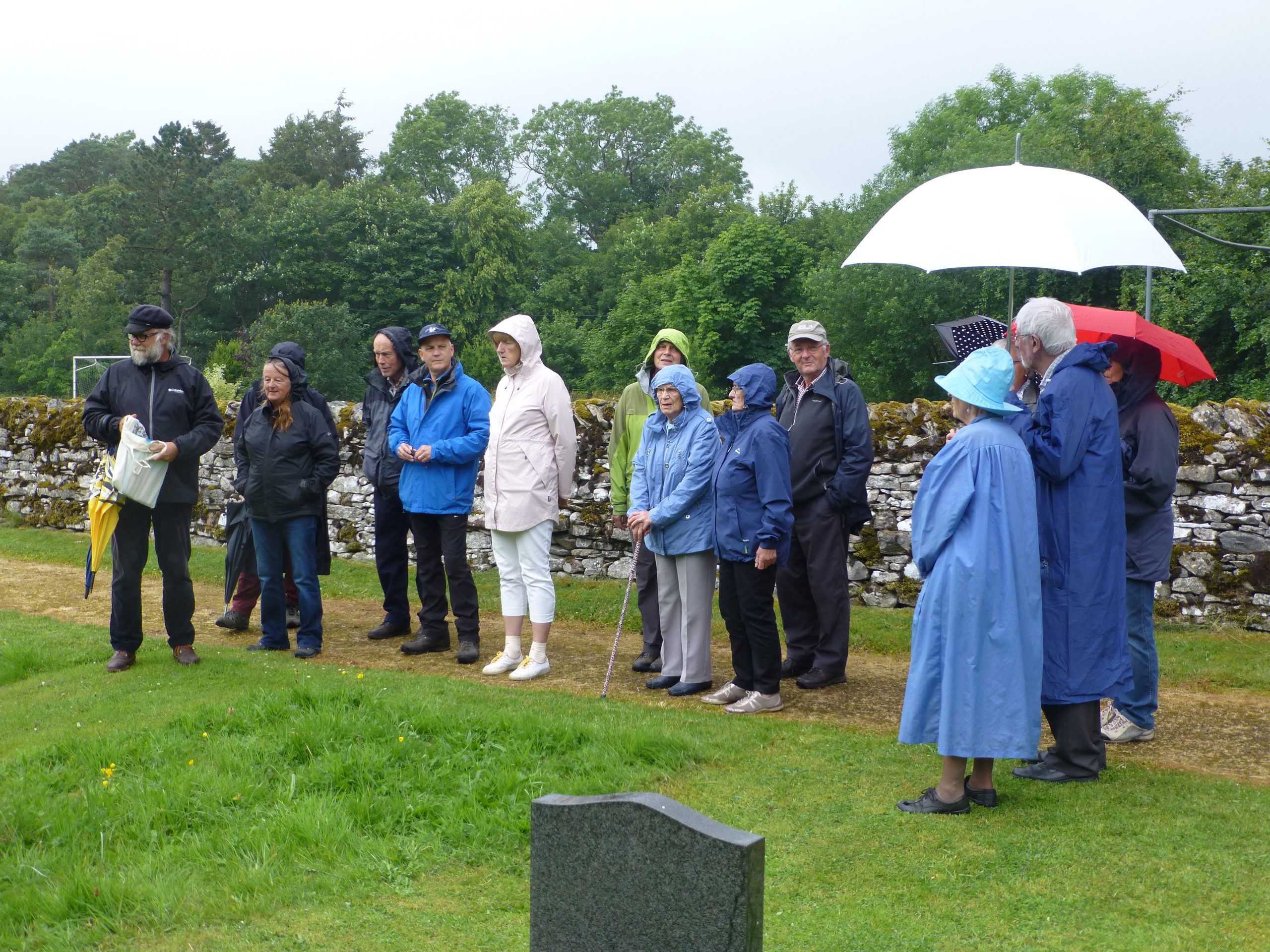 Our “summer” evening meeting was on Wednesday 17th July 2019 – not really summer weather unfortunately. Seventeen people enjoyed a stroll round Ravenstonedale village focussing on some of the buildings, both secular and religious, and the families linked to them. This included the mystery of why there are two identical gravestones – one in St Oswald’s Churchyard and one in High Chapel graveyard. Val Fermer’s research into the history of some local families was featured, and she and Steve have now published a book based on her research.
My Great-Grandfather was William Holme born in 1850 at Smorthwaite, Garsdale.
At the turn of the century he was employed by the Frankland family of Ravenstonedale, and in an article written by Mrs Frankland in her later years, she referred to employing a “good man, known as ‘Old Holme” who helped manage the estate, residing in a cottage there.
Has anybody of my Great-Grandfather William Holme who died at Rochdale, Manchester in 1926?
I am particularly interested in trying to locate any photographs of Mrs Frankland’s staff around this time.
Thank you.
Hi John, thank you for your message. We have information about your great-grandfather and will email you.