
The 2018-2019 programme of talks began on September 19th 2018.
Please click on Continue Reading to see details of all these talks.
On 20th March Steve Fermer gave the final talk in our 2018-2019 season which featured the rise and fall of the Shorthorn cattle breed in Ravenstonedale. Steve based his talk on material held in the Parish archives by the local History Group at High Chapel (thanks Steve!) and also widened his investigation to include personal recollections and records from local farming families and undertook an extremely useful visit to the local branch of the Rare Breeds Survival Trust. Anthony Metcalfe-Gibson who farmed at Park House in the mid 1800’s was a noted breeder of shorthorns, as well as a judge at national and international shows. Steve read (in character) a speech of Mr Metcalfe-Gibson’s which he gave to a gathering of farmers at Grayrigg in 1884 (the full text of which is kept in the Parish archive). The speech was critical of the shorthorn breeding techniques in Westmorland in the 1880’s, stating in no uncertain terms that it had been much better in the 1840’s.
Ravenstonedale was famous for its butter which was sold at a weekly market until the advent of milk collection from the local farms by lorry in the 1930’s – this meant that the perishable milk could be transported and sold more easily and did not need to be made into butter which had a longer shelf-life. Nowadays the local shorthorns are much reduced in number, but the emphasis is now on their beef rather than their milk, and this is now sold by some supermarkets as well as local farm shops. The audience certainly enjoyed Steve’s samples of locally produced shorthorn beef which he served before the talk!
On Wednesday 20th February local historian Les Neal gave an interesting and very informative talk on 700 years of history in Newbiggin-on-Lune from Torphin (1160) to the Forrests (1910). From his own research, Les first answered the question “Who was Torphin?” Torphin held large estates in Westmorland and Yorkshire, and did indeed give “the woods and pastures of Ravenstonedale [including Newbiggin]” to the Priory of Watton (in Driffield, Yorkshire) at some point between 1160 and 1180, some 160 years earlier than the date given by local historian Reverend Nicholls in his 19th century book The History and Traditions of Ravenstonedale. Les then went on to investigate the ownership of seven Newbiggin farms over the years, and having also researched the history of the local crofts, “a series of long narrow tenement plots arranged in a line”, he was able to show that Newbiggin was a new planned settlement of crofts shortly before Torphin’s gift of the land to the Priory of Watton. Finally Les focussed on Mrs Forrest, a woman recorded as owning at least 14 properties in Newbiggin in 1910. Although she was born in Gateshead in very humble circumstances, Les showed how Mrs Forrest not only survived child servitude to more wealthy relatives in a network of families including stonemasons, weavers, colliery managers and coopers, but also how she eventually prospered through her connections to families in Newbiggin, Muker and Dent. At the same time her story highlighted the movement of Newbiggin families across the Pennines to the north-east industrial landscape around Newcastle.
About 30 members and friends enjoyed Hilary Wilson’s informative talk on Wartime Farming in the Howgills on Wednesday January 16th. In 2008, Hilary published a book entitled Heritage of the Hills in collaboration with the late Judy Dunford, and the talk featured images from a collection of photographs taken in the late 1930’s and early 1940’s by the late Jim Cookson. The photographs belong to a collection owned by Margaret Postlethwaite and most were taken at the Postlethwaite family’s farm near Sedbergh. Hilary also brought many items from her own family’s collection of farming memorabilia – everything from old receipts to homemade tools, including a chopper for cabbages made from an old scythe blade by the local blacksmith. Many of the audience, as well as Hilary, had first-hand experience of life on a hill farm, and this led to much discussion and reminiscing after the talk!
Our annual Xmas get-together on Wednesday 12th December 2018 featured two quizzes which were enjoyed by all – thanks Dave – and also Bill’s accompaniments to our carol singing – thanks Bill – as well as Steve’s summaries of our first two talks of the season…unfortunately for some, the talk which would have provided the answers to some of the quiz questions was not featured! However our members then proved their knowledge of breeds of sheep, some quite obscure it must be said, while unscrambling the anagrams in the second quiz. Congratulations to the two winning teams! All in all, a great way to start the Christmas party season here in the village. Thanks to Ann for the lovely decorations and to all who brought food and drink – and helped with washing up afterwards!
The Friends of St Oswald’s Supper Theatre’s poignant and heartfelt performance to mark the centenary of the signing of the Armistice on 11th November 1918, which signalled the end of the fighting between the Allies and Germany, was entitled From Westmorland to the Western Front and was held in St Oswald’s Church on 9th November 2018.
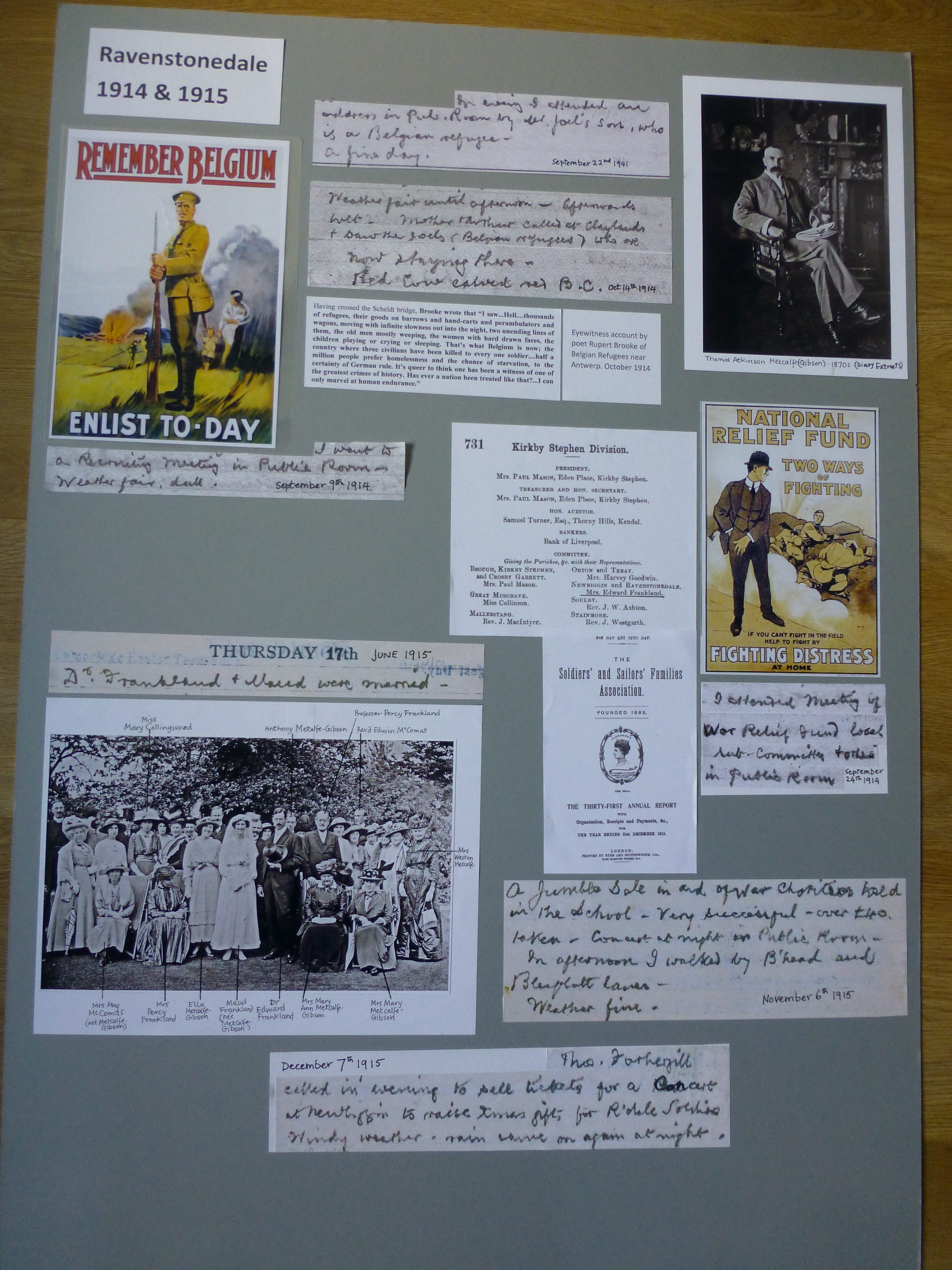
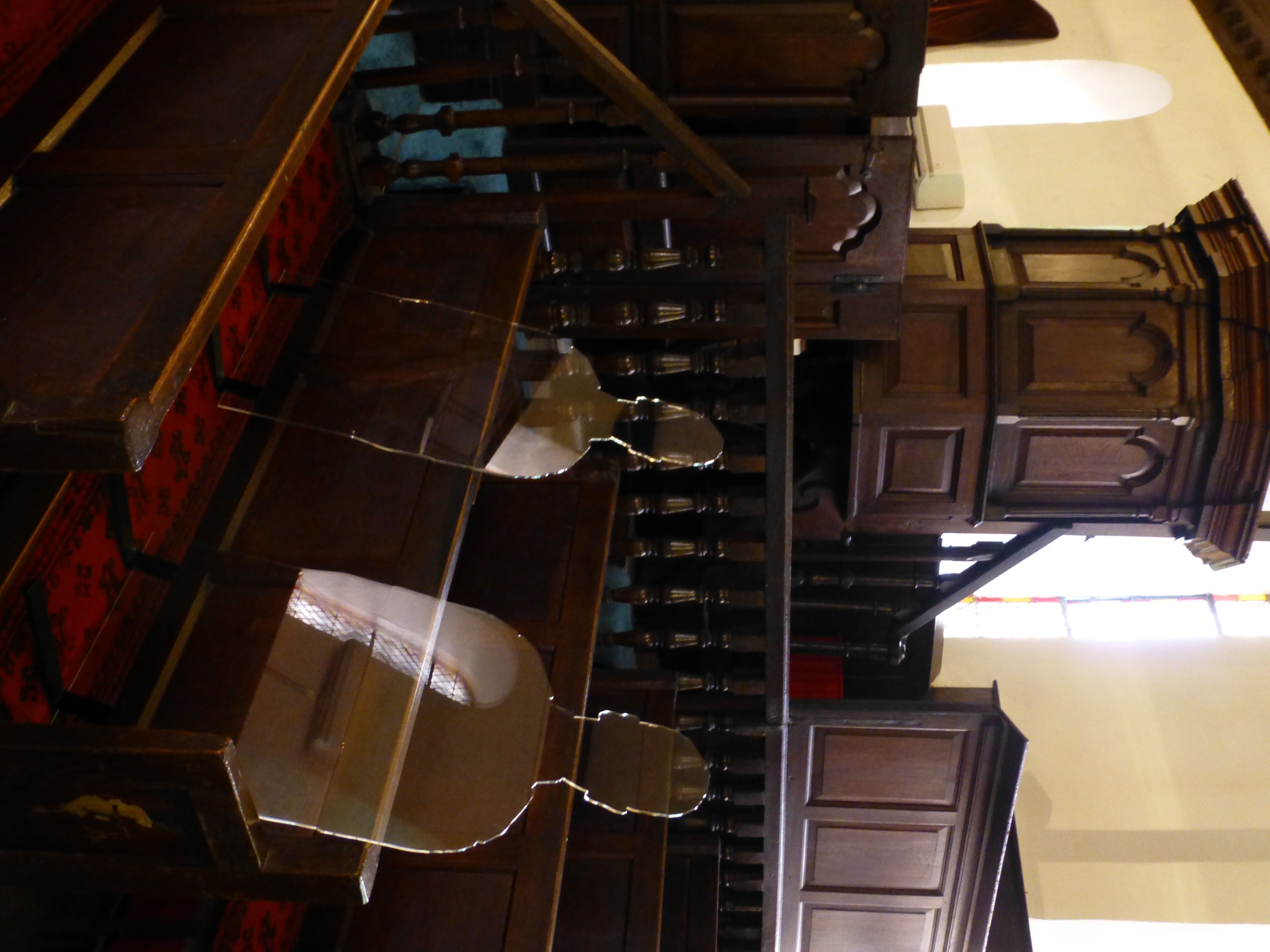
 The History Group were asked to put on an exhibition to accompany the play focussing on what life was like in the Parish during the War years – we are lucky to have two first-hand accounts in our Archive which formed the framework of our exhibition. The exhibition stayed in the Church over the Remembrance weekend, and we then moved it to High Chapel for Val Fermer’s talk entitled From the Western Front to Westmorland on Wednesday 21st November. Val had added to her research on the men who left the Parish to fight in the Great War but who did not return, but this time she also managed to find information about some of those who fought and then returned home. Such research can be very difficult, because in 1940 the building which housed the Great War service records was bombed and many records were lost entirely or damaged by fire and water, but despite this Val had succeeded in finding detailed historical information about all those had died and a selection of those who returned. These survivors served across all the theatres of War, including not only France and Flanders but Italy, Bulgaria, Mesopotamia and Salonica. After the War, some remained in the area but others left Westmorland for good. The History Group was pleased to welcome relatives of two of the men named on the War Memorial in St Oswald’s – one came to see the performance and the exhibition on 9th November, and the others came to the exhibition and Val’s talk. Part of the exhibition featured local diary entries which referred to the housing of Belgian refugees in the parish, and local fund-raising for the SSFA and the National Relief Fund. We also showed Great War letters and postcards from the Front as well as medals, kindly lent by members. Our four Parish There But Not There figures were placed in the Church during the performance of From Westmorland to the Western Front.

Our first talk of the season on Wednesday 19th September 2018 was a fascinating and informative account of Cattle Droving through Cumbria by Peter Roebuck, author of the book Cattle Droving Through Cumbria 1600-1900. Peter is Emeritus Professor of History at the University of Ulster, and we were especially pleased to welcome him as he is the current Chairman of Cumbria Local History Federation, to which we belong. A good turnout of members and non-members attended – in spite of the weather!
Our second talk of this season dealt with the Great War and its impact on Cumbria. Richard Preston has undertaken extensive research over many years into the subject and his talk entitled No Labour – No Food – No War on Wednesday 17th October in Newbiggin on Lune Public Hall (itself built in the immediate aftermath of the Great War as a place of recreation for the returning soldiers – to try and keep them out of the public house) focussed on the impact of wartime on farming in particular.
We enjoyed two summer evening history walks in 2018:
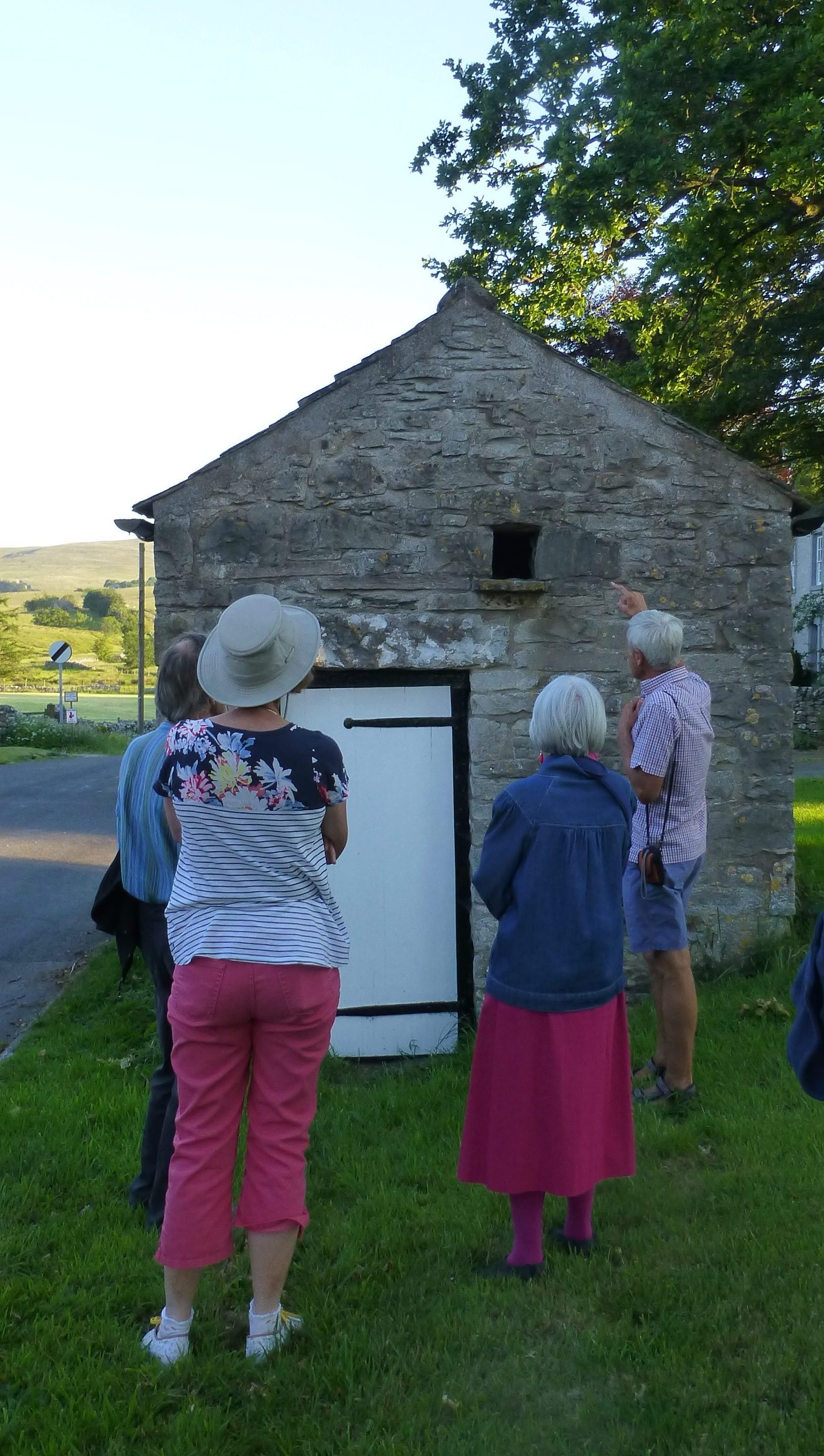
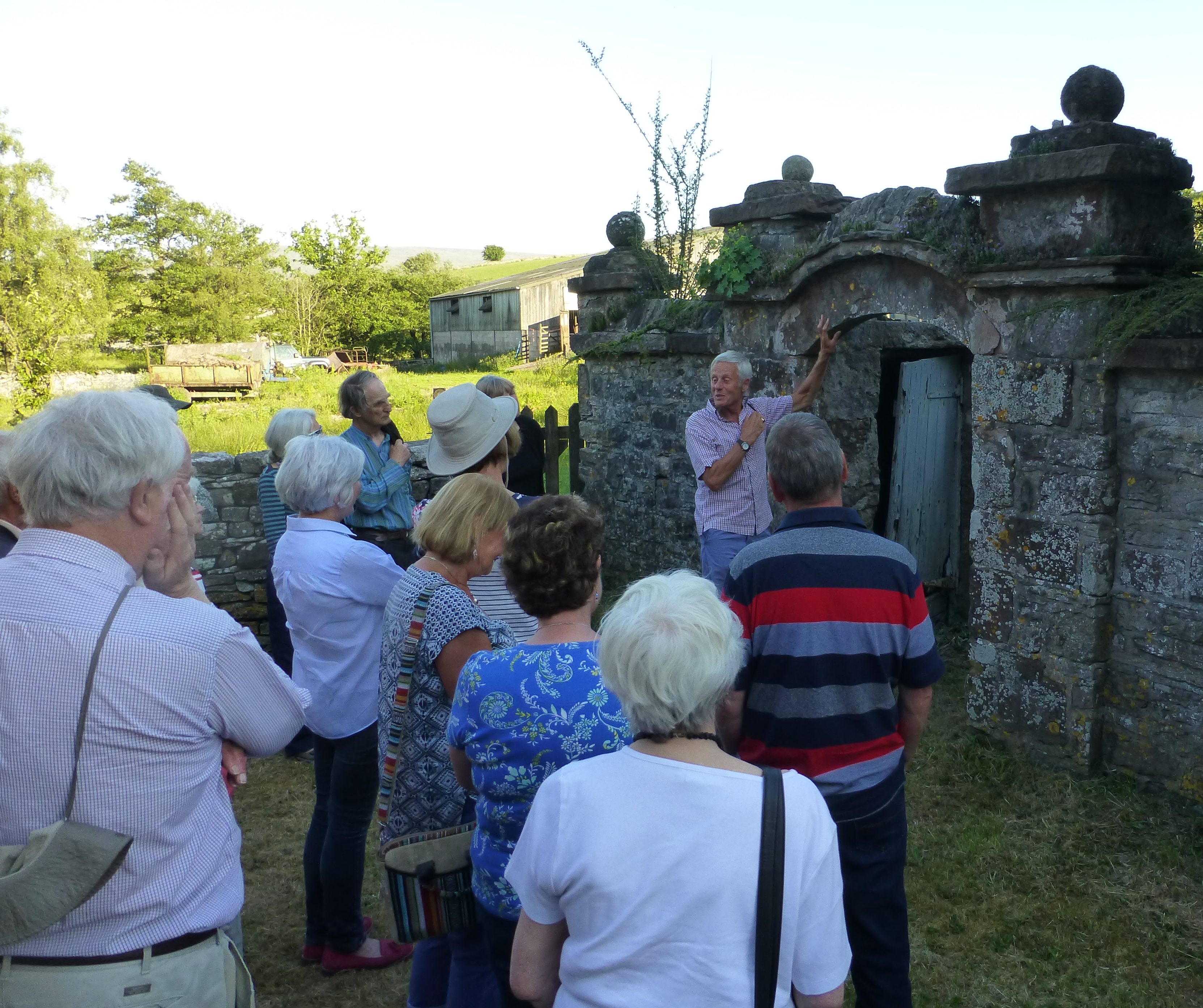
Our evening walk round part of Ravenstonedale village with Andy Lowe on 27th June – for once a beautiful summer’s evening – was attended by 28 people who were treated to a very informative and entertaining guide to what can be learned from looking at the outside of the houses, as to when they were built, and why certain features were designed as they were – most of which have stood the test of time and are still working well today. We’ll never walk through the village again without noting the clever designs to take rainfall away from windows, or how the carts were stopped from hitting the walls – or which house owners and builders were wealthy enough to incorporate the latest technology and fashions (sometimes many at once!) into their new houses. We also saw some of the more unusual window designs in the village as we walked up the main street. 

 Our thanks to Steve and Val for the refreshments afterwards, and our thanks also to those who were kind enough to let us view internal features such as a cruck beam, a (re-used) medieval timber post, cast-iron beam-mounted brackets for storage shelves, and original HL hinges too.
The second summer evening walk on Wednesday 11th July was led by local Orton resident and guide Wendy Higgins, and was an interesting two hour walk around Orton village. 14 members attended and enjoyed an informative talk on another warm summer’s evening. The tour started at the Market Hall, revealing the history of the very ancient market charter and a tale of an evening in the Vicar’s cellar that led to a court martial in the English Civil War. Orton Hall was discussed, and a number of buildings built by the Revd John Septimus Sisson, as denoted by initials in stone carved above the door of each property. On one of these properties, there is a porch possibly re-utilised from one of three vicarages built over the years. The Mill, now being faithfully restored as a dwelling, 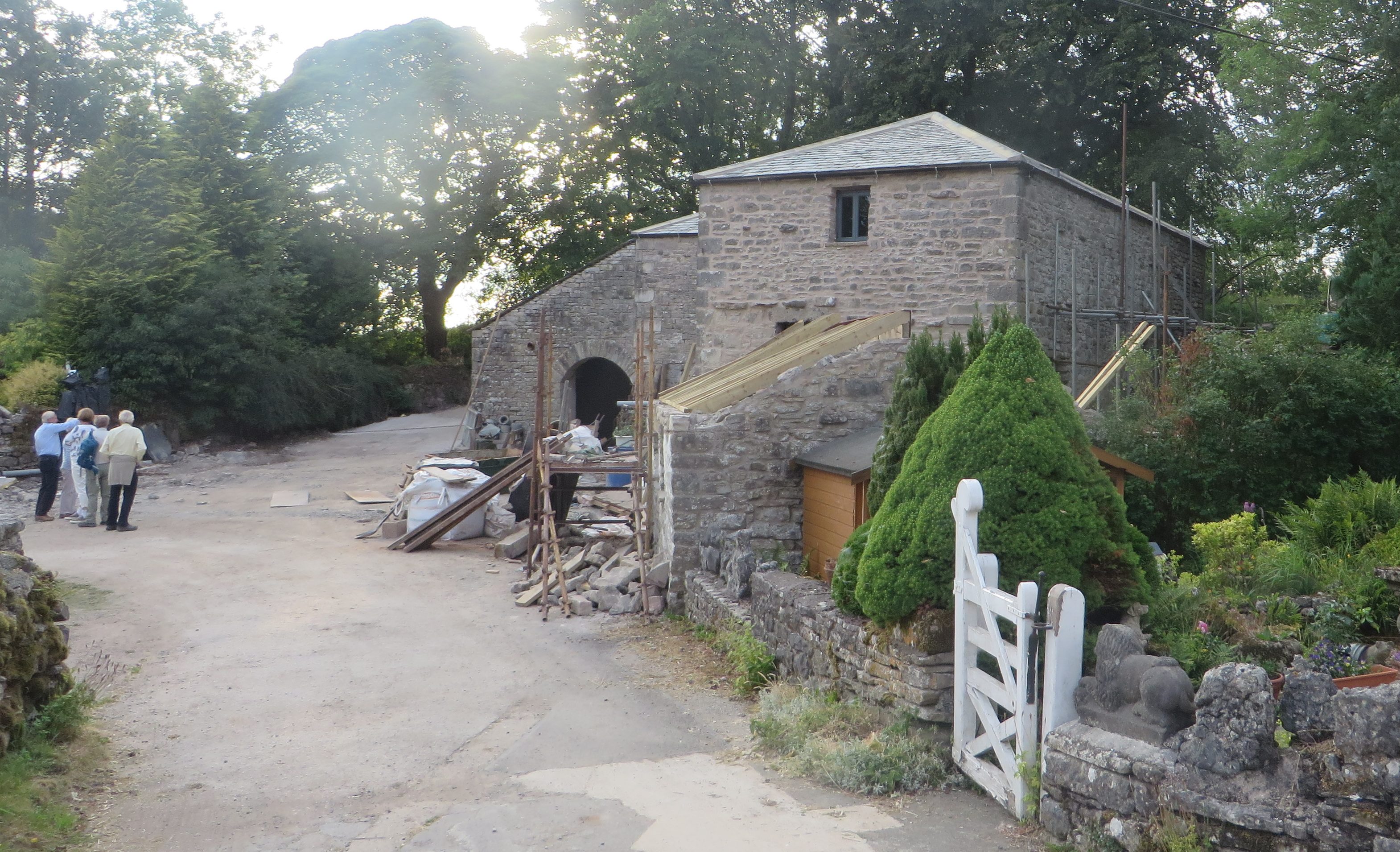 and other notable homes in the pretty lane along the Chapel Beck were described in terms of their history.
 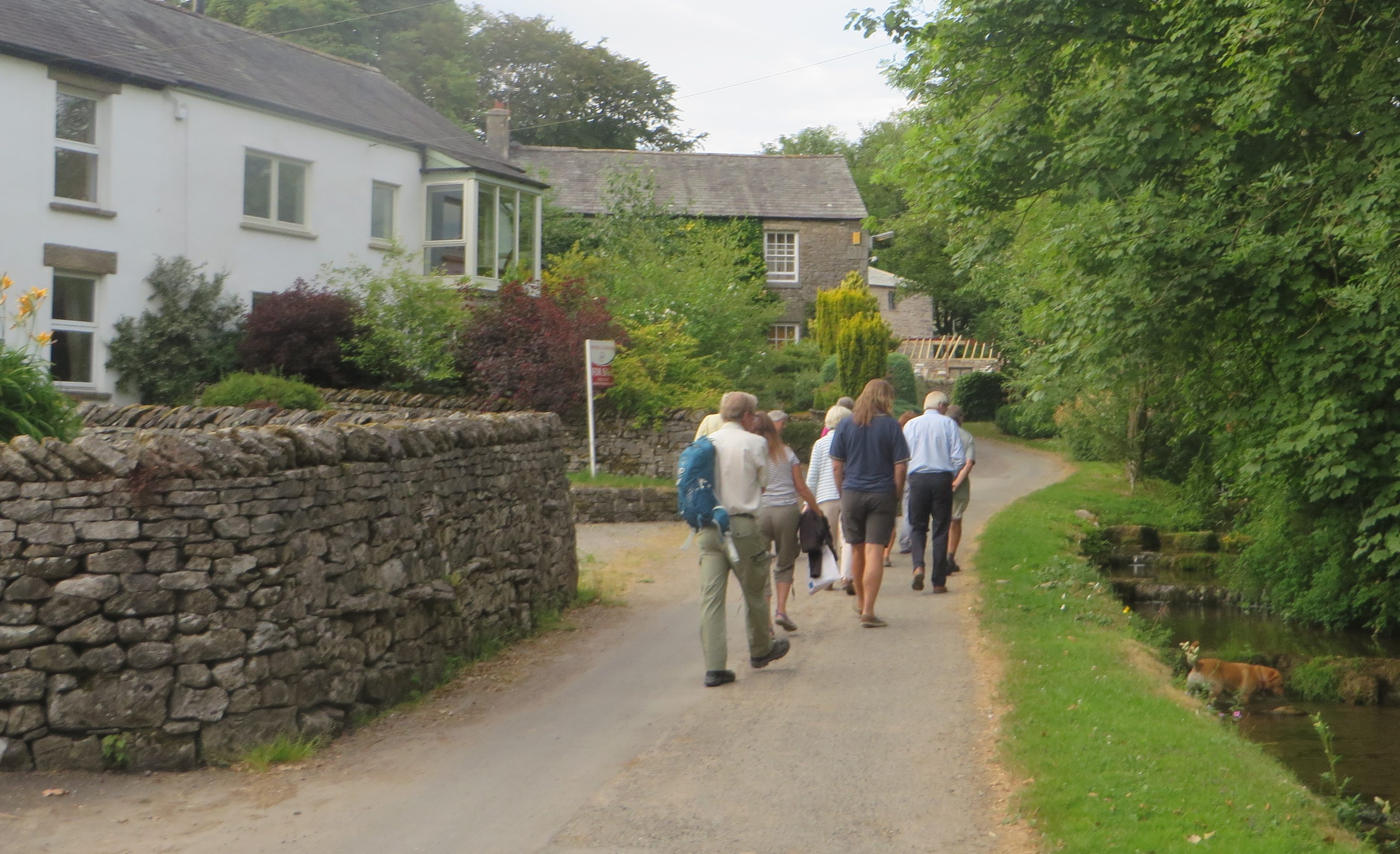 The walk concluded with a tour of the Church, showing features inside the building that give an insight into the date of construction including the ancient Parish Chest, and also the mystery door revealed in recent restoration work. Excellent tea and biscuits refreshed the walkers, who all thoroughly enjoyed the evening.
The Friends of Tarn Gill Bridge held their AGM, and had good reason to celebrate! Not only have Cumbria County Council (the owners) agreed to repair the bridge, but it has now been listed at Grade II by Historic England for its architectural and historic interest, and group value. The List Entry Number is 1455814 and HE have named it Artlegarth Beck Bridge.
Our final talk of the previous season was Les Neal’s presentation on 21st March 2018 on the changes in Ravenstonedale Town up to the early 1900’s, featuring stories of landowners, tenants and the farms and cottages. We learnt about the families who became part of the village’s history – some of the surnames have now disappeared from the village because the family had no male heirs, such as the Bovells. Les also showed how the houses and cottages had changed over time – Andy Lowe also focussed on this during his walk with us round Ravenstonedale village on the evening of 27th June.
On 21st February 2018 Jackie Wedd spoke about the life and work of Edward Jeffrey, a versatile and talented artist who lived in Ravenstonedale from the late 1940’s until just before his death in 1978. About twenty original watercolours by Edward Jeffrey were on show, kindly lent to the History Group for the evening – along with many well-loved copies of the Toby Twirl books, many of which show local Ravenstonedale references in his artwork. Other books with his illustrations were also on show. A summary of Jackie’s talk appears here, along with brief notes about previous talks last season:Professional illustrator, calligrapher and watercolour artist Edward Jeffrey lived in Ravenstonedale for the last thirty years of his life, and despite a busy art career also found time to take an active part in village life, serving as churchwarden, a member of the Bowls Club committee and auditor for the Tennis Club accounts. But how did this versatile artist become so successful in his chosen career? About forty people attended the illustrated talk and discovered how his art school training in Newcastle coupled with over twenty years’ experience in leading graphic design studios gave him the necessary skills not only to produce fine artwork, but also crucially to understand how it would be reproduced in printed form using the technology of the time – NB no computers! Asked to illustrate a series of children’s books in the late 1940’s, Edward Jeffrey based the leading character, Toby Twirl, on a soft toy made by his wife Bertha. His numerous illustrations often featured local buildings and scenes – meticulously drawn first in pencil, then Indian Ink, and then coloured. Meanwhile he continued sketching and painting watercolours, particularly landscapes and bird studies, and was elected to the Lake Artists Society in 1950, exhibiting regularly with them over more than twenty years – and he also exhibited nationally. He provided the cover illustration for Dalesman’s monthly Cumbria magazine for almost twenty years, and illustrated many of their books. He used his exquisite calligraphy to produce the illuminated Roll of Honour for the Parish and the lists of the High Chapel ministers and the Church vicars, as well as the Roll of Past Masters for Uter Pendragon Masonic Lodge in Kirkby Stephen. However he was such a modest man that many of the audience who knew him personally were unaware of all the sides to his talent. Jackie acknowledged the help given by members of his family and his friends during her research, and concluded by thanking everyone who had lent original paintings and well-loved Toby Twirl books for display during the evening.
On Wednesday 17th January 2018 Val Fermer gave an entertaining and informative talk on the history of the various licenced premises in the Parish. Despite the snowy weather, over 20 members and friends came to Newbiggin Public Hall to hear about the former establishments in Newbiggin, which over the years changed their names several times – being known variously as The Oddfellows, The Horseshoes, The Pig and Whistle and The Commercial Inn. Some of the current and former public houses in Ravenstonedale village and nearby had been temperance houses and coffee houses at various times in their past, and we were also treated to stories about the families of the numerous innkeepers and their customers, which included a dramatic elopement to Gretna Green, duly celebrated by the happy couple in one of the pubs on their return to the village!
For our first evening talk of the 2017-2018 programme on 20th September 2017 we were very pleased to welcome back Ian Carradice, who gave us glimpses of life in Ravenstonedale – and the wider world – from about 1905 to 1920, seen through the picture postcard album of his grandmother, Lizzie Fothergill, who lived at Wray Green, Fell End. Sometimes the interest in such albums comes from what is written on the postcards, not just the scenes depicted on the front, although some postcards were made from family portraits and photographs, which is fascinating from the point of view of family history research. Lizzie’s family were keen correspondents – as Ian pointed out, a postcard then was perhaps the equivalent of a text message sent now – but of course it’s available to future generations to study and learn about the day-to-day life of their ancestors…obsessions with health and haymaking were evident among the Fothergills which no doubt reflected common topics of conversation and concern (as in Ravenstonedale nowadays too!). It was a super talk – even though Ian pointed out it is a “work in progress” as he follows up all the leads – and we wonder how many of the audience went home and searched out their own family postcard albums to take out the cards and discover the messages hidden inside…
The evening talk on Wednesday 18th October in Newbiggin Village Hall at 7.30pm by John Dunning told the story of Westmorland Motorway Services which he and his family started when some of their farmland was compulsorily purchased to build the M6 motorway through the Lune Gorge. None of the usual motorway services providers were interested in building a service station between Lancaster and Carlisle (“not enough people would use it”), so the Dunnings decided they would start their own. Now as well as the two at Tebay, they own and run Rheged and the two Gloucester services on the M5 and have expanded into the Borders as well. All in all, a fascinating talk.
On 15th November Andy Lowe returned to give us another of his popular talks – this time entitled “Inside a Lakeland Farmhouse”. He showed us how much can be learned from clues inside these houses to do with methods of construction, those who lived there and their daily life, superstition, and social change. For instance, it was interesting to discover that the saying “a square peg in a round hole” was originally a good thing, not a misfit, as a square wooden peg in a round hole to fix two pieces of wood together would grip better than a round peg in a round hole. Of course there are examples of these 17th and 18th century houses and barns around our Parish too, and we hope to fix up an evening walk around some of them with Andy next summer. Keep an eye on the website for details.
Our annual Ravenstonedale Parish History Group newsletter was published in early September and emailed to all members. Members who do not have access to email receive a copy in the post. Please note that the venue for Les Neal’s talk on 21st March 2018 will now be in High Chapel. This is a change from the venue shown in the newsletter.
Over summer 2017 we organised several events.
On Friday 1st September eleven members of the History Group visited the Swaledale Museum in Reeth, where the Curator Helen Bainbridge gave us insights as to how we could best reorganise our ever-growing archive to make it more easily accessible to members and researchers, particularly those interested in their ancestral ties to the Parish. We are also discovering families who migrated in the past between Swaledale, Arkengarthdale and the Eden Valley (nowadays linked by the spectacular route from Kirkby Stephen through Nateby). We can thoroughly recommend a visit to the Museum – probably more than one as there is so much to take in! Their website is at http://www.swaledalemuseum.org/index.html
The History Group AGM was held on Wednesday 17th May 2017 at 7.30pm. Our thanks to all the members who attended. Our Treasurer and Membership Secretary who has filled these roles since the Group began is now standing down. We are very pleased that we have had a volunteer (yes really!) to join the committee and details of the new committee and their responsibilities are in the Newsletter, which has been emailed or sent to all members.
On Thursday 22nd June, some members of Hesket Local History Group visited Ravenstonedale for a walk around the village, similar to the walk we organised for Shap Local History Society last year. We visited the Church and the Coldbeck area before returning along High Dykes to Townend, and then walked up the hill past Low Chapel to High Chapel. Three members of our committee kindly shared their local knowledge about the buildings and the history of this part of the village and it was much appreciated by the visitors, and also by some local people who joined the walk.
Four Ravenstonedale village gardens, the allotments and the Kilnmire traditional haymeadows (as pictured in High Chapel) were open for the National Garden Scheme over the weekend of 1st and 2nd July. The History Group put on an exhibition of photographs of Parish Gardens Past and Present in High Chapel, where the refreshments were on sale between 11am and 5pm each day. The exhibition showed photos and plans of former Victorian Parish gardens, as well as photos taken during Parish “garden trails” in the early 2000’s which raised funds for St Oswald’s Church. There was also a display about the history of Tarn Gill Bridge (aka Chantry Bridge) and the History Group’s contribution to the Friends’ ongoing efforts to save the bridge from demolition. Some folders featuring previous Local History exhibitions were also on display.
The NGS opening raised over £2500 for the various nursing, medical and carers’ charities which are supported, and this includes over £700 takings from the excellent teas, coffees and cakes served in High Chapel co-ordinated by the High Chapel Community and Heritage Centre Committee. 50% of the refreshments takings goes to High Chapel and 50% to the NGS for their charities.
On Wednesday 19th July, eight History Group members enjoyed a guided walk around Shap by kind invitation of Shap Local History Society. Arriving in a torrential downpour, we sought refuge in the Heritage Centre where we were given an introductory talk by Jean Scott-Smith. When the rain stopped, we visited the church and walked around the village, noting the different styles of architecture and hearing about aspects of life in Shap from pre-history onwards…ending up back at the Heritage Centre for delicious homemade scones and cake! Our thanks to Jean and to Liz for their hospitality.
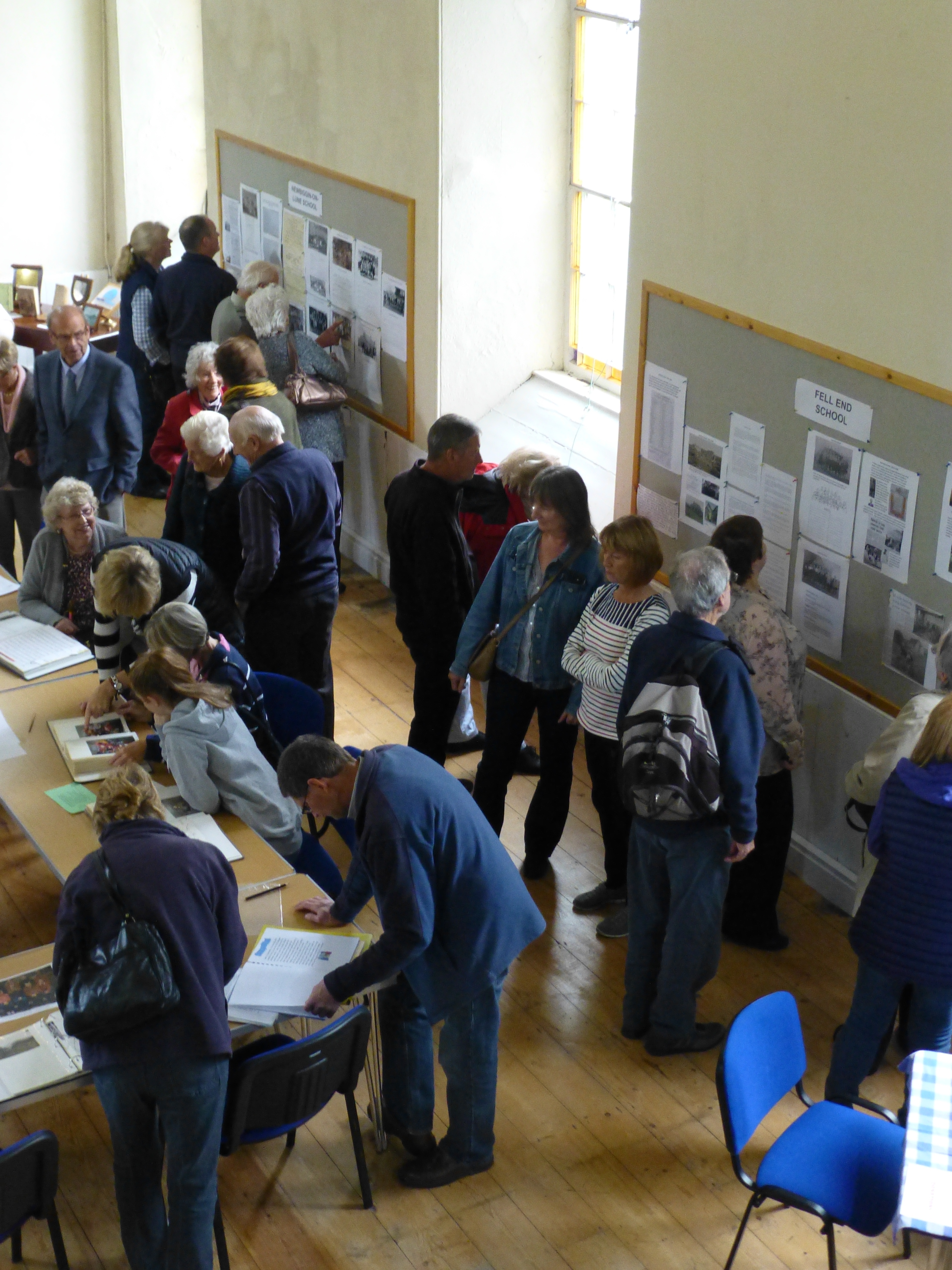
The 2016 exhibition entitled The Three Parish Schools – or is it Four? on 8th and 9th October 2016 was a great success – over 100 people attended over the two days and we were very pleased to welcome former pupils from Ravenstonedale, Newbiggin-on-Lune and Fell End Schools who were able to help us identify many of the pupils in the school photographs we have been given. Our thanks to everyone who lent or donated items for the exhibition – we are particularly pleased to have been able to show the cast-iron fireguard which stood round the stove in Fell End Schoolroom to one of the former pupils who used to stand next to it to keep warm during the 1940’s when she attended the school from the age of 5.
The first evening meeting of the 2016-2017 season was on Wednesday 21st September 2016, and was a talk by our Chairman, Val Fermer, entitled A Ravenstonedale Entrepreneur, with Connections to Carts, Canals and Cotton. Val gave an account of the Carver family and in particular John, who came to own many properties in the village. The family was connected to Ravenstonedale through marriage (William Carver, John’s father, married Elizabeth Airey).
Although he never actually lived in Ravenstonedale, John Carver’s property portfolio at his death in 1911 included The Black Swan, The Chantry, The Bield (then known as Mrs Haygarth’s House) and many other dwellings, mostly in the main street. Val’s talk included references to John’s twin brother Thomas – the two were as different as chalk and cheese – and their sister Mary Isabella, who lived in The Chantry for a time, as well as showing how the family’s wealth was derived first from transporting goods by road and canal and then from cotton.
Trevor Avery’s talk on 19th October 2016 about the Ambleside Child Survivors of the Holocaust explained why and how children liberated from the death camps came to live in the Lake District immediately after the war. He included sound recordings of some of his interviews with survivors in later life, which were both moving and thought-provoking.
The well-attended talk on 16th November 2016 by Dave Williams from Upper Eden History Society entitled Westmorland Maps was an informative look at the history of maps of the former county from 1350 onwards (excluding the Ordnance Survey). Dave brought some maps from his own collection to show how the information became more accurate as the science of mapping developed, although there were still anomalies such as incorrect depictions of the ward boundaries and hills. It was obvious too, how mapmakers through the centuries varied the county’s shape – and the habit of showing railway lines which were planned for the future, but were then built following a different route, must have been confusing for users…in one case, both routes were shown on a later map! Eventually however, science and art combined to make beautiful, accurate, illustrated maps of the county – the last, and arguably the best, being Wainwright’s map which was commissioned to show the county in 1974 before it vanished due to the boundary changes.
Our annual Christmas get-together of members and friends took place on 7th December 2016 in the High Chapel Community and Heritage Centre. We enjoyed mulled wine, nibbles and mince pies – with soft drinks on offer for those who unfortunately had to drive – and we were treated to another of Les Neal’s entertaining quizzes. He did promise it would be easier than last year’s on the Norse-derived place names in the Parish – hmmm! If you are a devotee of BBC2’s Only Connect you will understand it when I say that the “Christmas Connecting Wall” – including anagrams as well – seemed very difficult to me, although the “missing consonants” section (rather than the Only Connect missing vowels) was slightly easier. The winning team managed to remember all Santa’s reindeer names (including Rudolf of course), not to mention all the gifts in the Twelve Days of Christmas in the correct order, and were presented with their prize of a bottle of wine made from grapes grown in the village. Congratulations to them and our thanks to Les and to our members who helped with decorating the hall – and the washing-up afterwards!For those still intrigued by the Norse names from last year’s quiz, they include “by the brown hill” – Brownber, “by the sandy ford” – Sandwath, “on the gorse hill” – Brackenbar, “near the small ravine with the alder trees” – Ellergill, and “on the long sloping hill used for summer pasture” – Lytheside.
Val’s second talk of the season was on Wednesday 19th January 2017 when she told us about members of eleven families from the Parish who, for various reasons during the nineteenth century, left to seek their fortunes in Manchester, and in some cases then emigrated further afield. Most were successful – but one man in particular came to an unfortunate end. Some of the families involved were Airey, Blackett, Buck and Udall. As usual, a copy of the text of Val’s talk will be available in due course in the History Room upstairs at High Chapel.
On Wednesday 15th February 2017 at 7.30pm Jean Scott-Smith gave a talk entitled Over Shap by Track, Road and Rail. Some of us heard Jean give part of this fascinating talk, dealing with the impact of the building of the railway over Shap, at the CLHF Annual Convention last November. We were pleased that she agreed to come at short notice to give us a more complete history of transport over the challenging terrain of Shap, as our speaker originally booked for this date was unable to come. Starting with evidence of a track over the Shap Fell in Neolithic times, we learnt of the route followed by Bonnie Prince Charlie in 1745 (the “old road”), which was realigned when the Heron Syke Trust turnpike was built, and which eventually became the modern A6. Parts of the old route can still be traced between Kendal and Shap village. We are looking forward to our visit to Shap on 19th July, when we will have a guided walk through the village hosted by Shap Local History Society. Further details will appear on our website in due course.
On Wednesday 5th April 2017 at 7.30pm Janet Niepokojczycka gave a talk entitled Packhorse Days and Packhorse Ways. Janet shared some of her own experiences travelling with packhorses up and down the country, as well as sharing facts about the use of packhorses and the items they carried more than 300 years ago (including smuggled goods), when roads were either poor or non-existent. She was interested to see the display about Tarn Gill Bridge at the south end of the village and the efforts by Friends of Tarn Gill Bridge to preserve this eighteenth century bridge, which was under threat of demolition by Cumbria County Council.
I would like to hear rom Jackie Wedd about the talk on 20th May 2016 on Edward Jeffrey, the artist famous for his illustrations of “Toby Twirl”, written by Sheila Hodgetts.
I am currently researching material on Hodgetts and Jeffrey.
I am a retired university lecturer in Australia, hoping to find help for my work via the internet and e-mail.
John Gough
Hi John – please see our reply to your other comment! We’ll be in touch.